


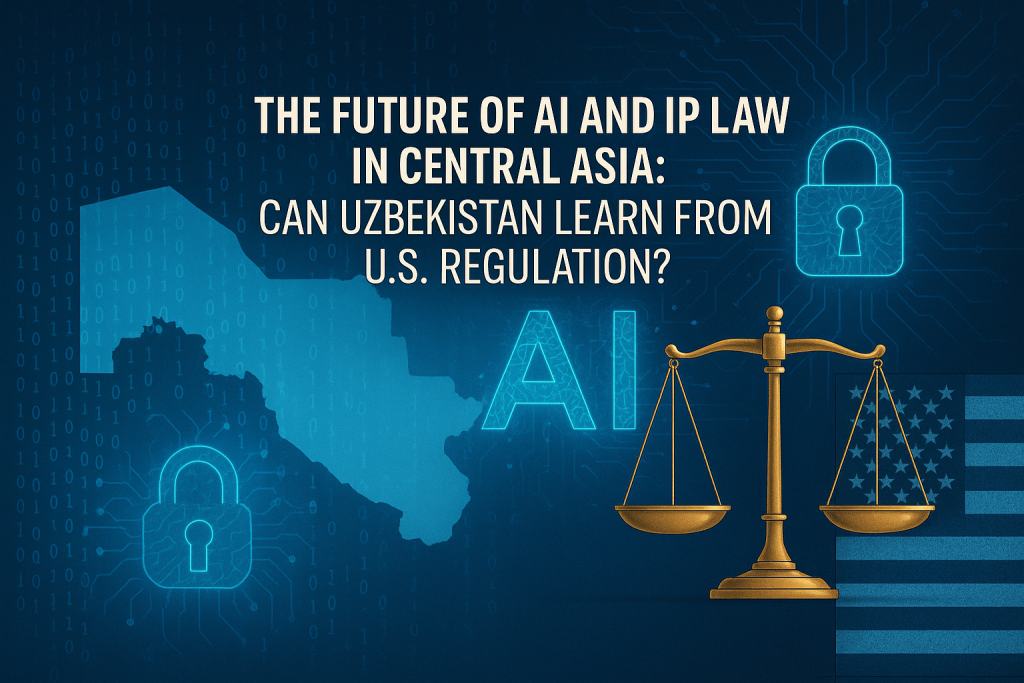
Artificial intelligence is no longer just a Silicon Valley buzzword. From automated translation apps to generative models producing original works, AI has become an undeniable driver of innovation worldwide. For countries in Central Asia, especially Uzbekistan, the question is not whether AI will shape the economy, but how quickly the legal system can adapt to regulate it.
One of the most pressing issues is intellectual property protection. In the United States, debates around AI and copyright have been highly visible. The U.S. Copyright Office has repeatedly emphasized that works generated entirely by AI without human involvement are not eligible for copyright protection, as seen in the Thaler v. Perlmutter decision. Yet, companies continue to push the boundaries, asking whether partial human input combined with AI should grant legal rights. This has created a dynamic, though unsettled, legal environment that Uzbekistan can learn from.
In Uzbekistan, the IP system has been steadily modernizing, but it has yet to face large-scale disputes over AI-generated works. Current laws still assume that authorship belongs to a human creator. This is not unique—most legal systems worldwide share this foundation. But as Uzbek tech startups, universities, and even government institutions begin to experiment with machine learning tools, questions will inevitably arise: Who owns the code-generated content? What rights do artists have if their works were used to train AI systems without permission? And how can innovation be encouraged without undermining creators’ rights?
Another dimension is data protection and cyber law. In the U.S., AI has sparked lawsuits not only over copyright but also over privacy and misuse of personal information. The U.S. has a fragmented approach—different states, such as California with the CCPA, have introduced their own frameworks. Uzbekistan, in contrast, is in the early stages of building its personal data protection system. This gives the country an opportunity to design a more unified and forward-looking model, potentially avoiding the patchwork challenges seen in the U.S.
What makes this even more urgent for Uzbekistan is its growing ambition to become a digital economy hub in Central Asia. Government programs like the “Digital Uzbekistan 2030” strategy aim to expand AI adoption across education, healthcare, and commerce. With such rapid digitalization, gaps in regulation could quickly become vulnerabilities. For example, without clear rules on ownership, foreign investors may hesitate to back AI startups. Similarly, weak data protections could undermine public trust in new technologies.
For Central Asia more broadly, Uzbekistan could become a regional leader if it adopts clear and balanced rules on AI and IP law. Learning from the U.S., Uzbek lawmakers can anticipate disputes before they arrive in courtrooms. This means defining authorship in the context of AI, establishing fair guidelines for the use of training data, and strengthening data protection laws to guard against misuse. Regional cooperation with neighbors like Kazakhstan and Kyrgyzstan could also help build a harmonized digital legal space, reducing risks of regulatory fragmentation.
Ultimately, the future of AI and IP law in Uzbekistan depends on how quickly it can bridge global best practices with local realities. The U.S. offers both lessons and warnings: rapid technological change can outpace legal adaptation, but proactive regulation can also foster innovation while safeguarding rights. For Uzbekistan, the moment to act is now—before the AI revolution moves from theory to daily practice in every sector of society.
Shokhjakhon Abdusattorov, LL.M, Penn state law,





 EN
EN  UZ
UZ