

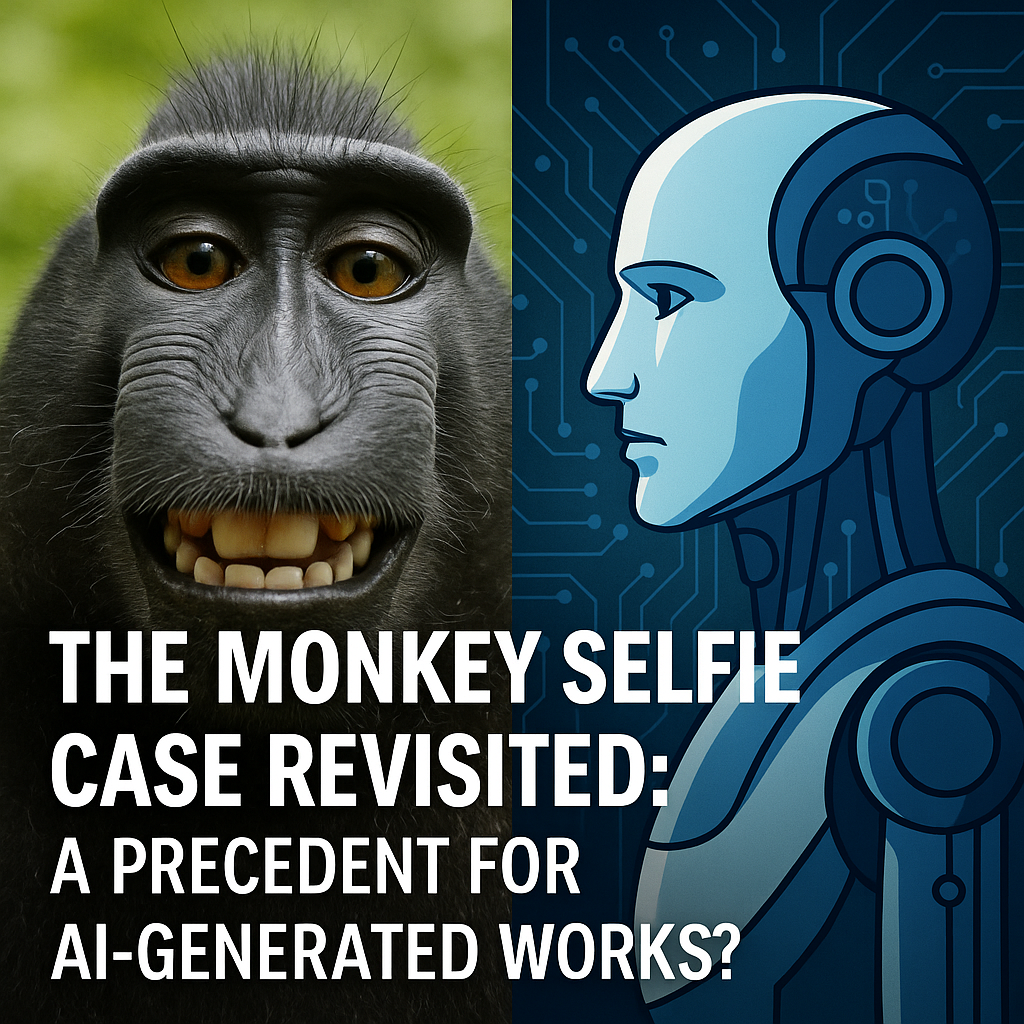
The Monkey Selfie Case Revisited: A Precedent for AI-Generated Works?
In the ever-evolving world of intellectual property (IP) law, one curious legal battle continues to echo through the chambers of copyright theory: the Monkey Selfie Case. While the case itself involved an animal — not artificial intelligence — its implications offer surprising parallels for our modern questions about authorship and AI-generated content.
📸 What Was the Monkey Selfie Case?
In 2011, British nature photographer David Slater set up a camera in the Indonesian jungle. A crested macaque named Naruto got curious and clicked the shutter — producing several surprisingly well-framed selfies. These photos quickly went viral.
The legal question emerged soon after: Who owns the copyright to a photo taken by a monkey?
Was it the photographer who set up the equipment? The monkey who pressed the button? Or did no one own it?
In 2015, animal rights organization PETA filed a lawsuit on behalf of Naruto, claiming the monkey should hold the copyright. The Ninth Circuit Court of Appeals eventually ruled that animals cannot hold copyright under U.S. law, and the case was dismissed. The court stated that copyright law protects “original works of authorship fixed in any tangible medium,” but authorship must be human.
🤖 So, What Does This Have to Do With AI?
Now, let’s fast forward to 2025. AI systems like DALL·E, Midjourney, and ChatGPT can generate stunning images, text, and even music — all without human creativity in the traditional sense.
This brings us back to the same question:
If something non-human creates an original work, who owns it — or does anyone?
Much like Naruto the monkey, AI is not a human. Yet, it produces outputs that resemble creative human works. U.S. Copyright Office guidance currently states that works “generated entirely by a machine” without human involvement are not eligible for copyright protection.
So here lies the connection:
-
In both cases, non-human entities (a monkey or an AI) created a work.
-
In both cases, courts or agencies rejected copyright ownership because the “author” was not human.
-
The question of ownership and authorship remains contested, especially when human involvement is partial or indirect.
⚖️ Key Implications for IP Law
-
No Person = No Protection?
If a work has no human author, it may fall into the public domain. This raises issues for companies or creators who invest in AI tools expecting exclusive rights. -
Partial Human Input Matters
If a human guides the process — selects inputs, curates results, or edits AI outputs — courts might consider granting protection to the final product. But how much input is “enough” remains unclear. -
Ownership by Proxy?
Just as David Slater argued he owned the monkey’s photo due to setting the conditions, developers or users of AI systems might claim ownership. But the legal clarity is lacking. -
Legislative Uncertainty
Countries like the U.K. and China have begun to recognize AI-assisted works in some capacity. But the U.S. still holds a firm line on human authorship — for now.
🌍 Global Outlook: A Patchwork of Rules
-
U.S.: Strictly human authorship. AI-only works are not copyrightable.
-
U.K.: Offers limited protection to computer-generated works, granting authorship to the person who made the arrangements.
-
China & Japan: Exploring frameworks to recognize or regulate AI-generated content more explicitly.
This legal patchwork creates uncertainty for creators and developers operating across jurisdictions.
🧠 So… What Can We Learn from the Monkey?
The Monkey Selfie Case reminds us that authorship matters deeply in copyright law, and non-human creators challenge our traditional definitions.
As AI continues to evolve, the legal world faces a crucial question:
Should copyright law adapt to include intelligent machines — or should it remain a human-only domain?
Just like Naruto inadvertently triggered a global legal debate, AI may force courts and lawmakers to rethink the very foundations of creative ownership.
📌 Final Thought
While a monkey with a camera may seem worlds apart from generative AI tools, both challenge the same idea:
Who is the true creator — and who deserves the rights?
Whether you’re an artist, coder, or legal scholar, it’s time to revisit old cases through new lenses.


 UZ
UZ  EN
EN