


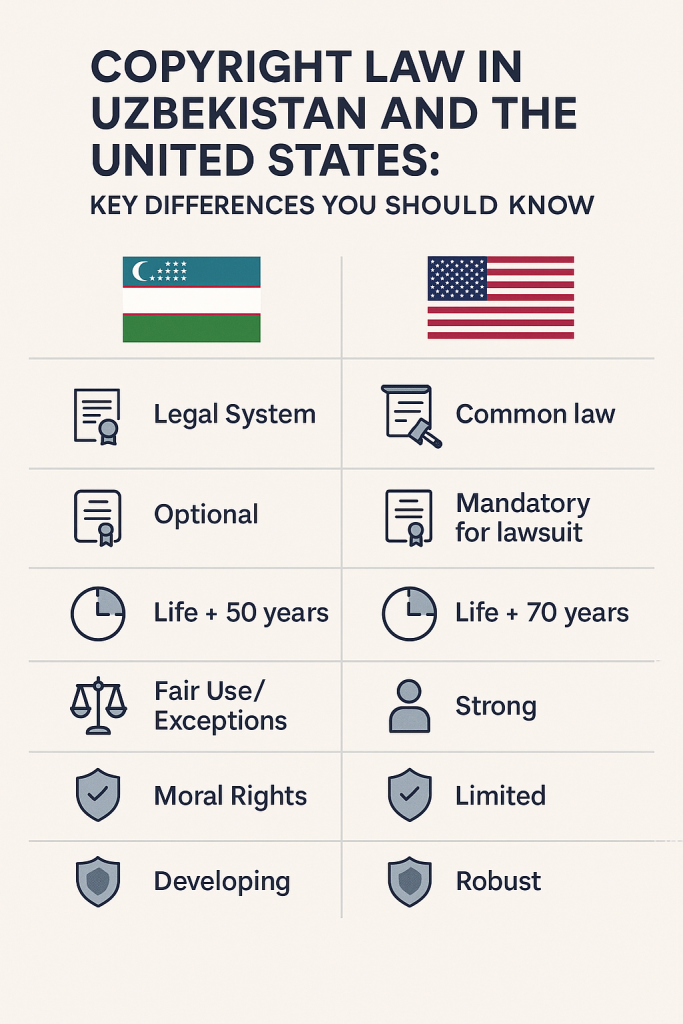
Copyright Law in Uzbekistan and the United States: Key Differences You Should Know
In today’s global digital age, creative works can reach audiences across borders in seconds. But when it comes to copyright law, those borders still matter—a lot. While both Uzbekistan and the United States recognize the importance of protecting creative works, their approaches to copyright are built on very different legal traditions and frameworks. If you’re a content creator, startup founder, lawyer, or simply someone working with intellectual property across both countries, understanding these differences is not just useful — it’s essential.
🧩 1. Legal System and Philosophical Foundations
The first key difference lies in the legal systems themselves.
-
Uzbekistan follows a civil law system, heavily influenced by European and Soviet legal traditions. Copyright is regulated mainly through written legislation, especially the Law on Copyright and Related Rights (2006).
-
The United States, in contrast, operates under a common law system, where case law and judicial interpretation play a central role. Its copyright law is governed primarily by the U.S. Copyright Act of 1976, with ongoing judicial developments shaping its interpretation.
This means that in Uzbekistan, what is written in law is paramount, while in the U.S., what the courts have said often carries equal—if not greater—weight.
🧾 2. Automatic Protection and Registration
Both countries recognize automatic copyright protection upon creation of a work.
However, the registration process and its legal implications differ significantly:
-
In Uzbekistan, registration is optional and mostly symbolic, though helpful as evidence in disputes.
-
In the United States, registration is mandatory if you want to file a lawsuit for infringement and claim statutory damages.
➡️ Bottom line: If you’re a creator working in the U.S., not registering your work could leave you without a remedy in court.
📅 3. Duration of Copyright Protection
Another notable difference is the term of protection:
-
Uzbekistan: Copyright lasts for the life of the author plus 50 years after death.
-
United States: Copyright lasts for the life of the author plus 70 years, under the Sonny Bono Copyright Term Extension Act.
For anonymous or corporate (work-for-hire) works:
-
Uzbekistan: 50 years from publication.
-
U.S.: 95 years from publication or 120 years from creation, whichever is shorter.
This longer protection period in the U.S. gives authors, heirs, and corporations broader control over their works.
📌 4. Fair Use vs. Exceptions
The U.S. recognizes “fair use” — a flexible, judge-made doctrine allowing limited use of copyrighted works for purposes such as criticism, education, and parody. There is no fixed list; each case is evaluated based on four legal factors.
Uzbekistan, instead, follows a more narrow list of statutory exceptions, such as use for educational or scientific purposes. These are written in the law and interpreted more strictly.
So, what’s acceptable under U.S. “fair use” may still be illegal in Uzbekistan.
👥 5. Moral Rights
-
Uzbekistan provides strong protection for moral rights, such as the right to claim authorship and the right to object to distortion or modification of a work. These rights are perpetual and cannot be waived.
-
In the U.S., moral rights are limited. They apply mainly to visual artists under the Visual Artists Rights Act (VARA) and are not as deeply embedded as in Uzbek or European law.
For creators concerned about how their work is modified or credited, this is a crucial distinction.
🌐 6. International Treaties and Enforcement
Both countries are parties to key international agreements such as the Berne Convention, which mandates minimum standards of protection.
However, enforcement in practice may vary:
-
The U.S. has a robust system of civil litigation, statutory damages, and even criminal penalties for willful infringement.
-
Uzbekistan has legal enforcement mechanisms, but in practice, copyright litigation remains relatively rare and underdeveloped.
🎯 Conclusion
If you’re a creative professional, entrepreneur, or legal expert working in both Uzbekistan and the United States, it’s essential to understand how differently these two countries treat the same core concept of “copyright.”
Knowing the duration, registration, fair use, moral rights, and enforcement differences can save you from costly mistakes and help you make smarter decisions about protecting your intellectual property globally.
Shokhjakhon Abdusattorov






 UZ
UZ  EN
EN