


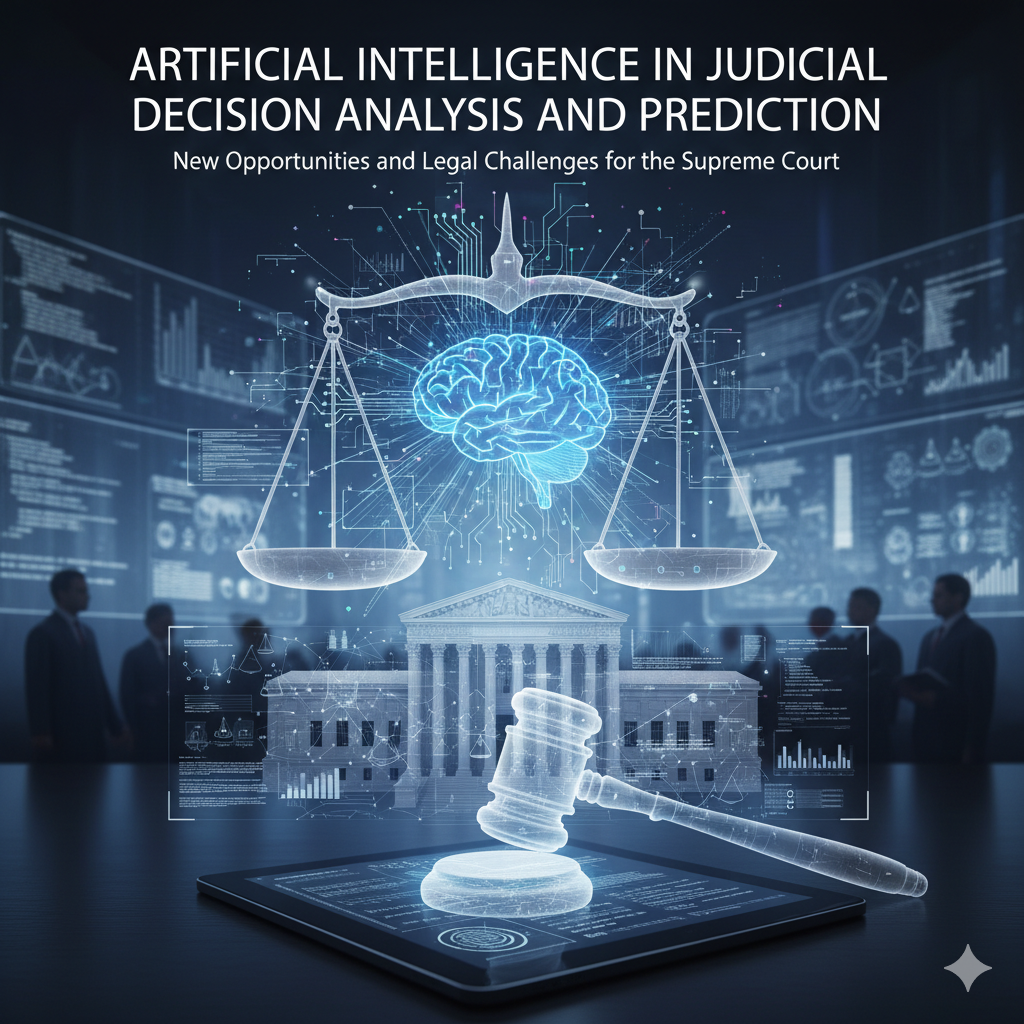
Artificial Intelligence in Judicial Decision Analysis and Prediction: New Opportunities and Legal Challenges for the Supreme Court
By Azizjon Jamolov, Head of Plenum and Presidium Department of the Supreme Court of the Republic of Uzbekistan
Justice is the foundation of every society, and courts are the pillars that uphold that foundation. Today, rapid technological advances pose both fresh opportunities and serious challenges to the judicial system. Artificial Intelligence (AI) is one such advance. It holds transformative potential for analyzing past judicial decisions and predicting outcomes—but its legal, ethical, and institutional implications must be managed with care. As a leader in the Supreme Court, I firmly believe that our guiding principles—precision, transparency, and respect for human rights—must be preserved even while we explore how AI can be integrated into judicial practice for the common good.
In recent months, Uzbekistan has taken major steps toward integrating AI into its judicial structure. One key measure is Presidential Decree No. 140, titled “On Additional Measures for the Introduction of Artificial Intelligence Technologies in Court Activities to Increase Access to Justice and Improve the Material and Technical Support of the Judicial System.” This decree mandates the gradual transition to fully electronic case management under the “Digital Court” concept, eliminating paper-based workflows. It also provides for expanded interactive electronic services for citizens—such as obtaining copies of court documents, reviewing case materials online, determining jurisdiction, and calculating court fees via AI. Additionally, a judicial archive module will be created within the Supreme Court’s information systems; there will be remote participation in hearings; draft judicial documents will be generated automatically; hearing transcripts will be prepared in real time using AI tools; and court fees can be paid and determined online. Experimental digital courtrooms for civil, administrative, and economic cases will be established in Tashkent by the end of 2025. The decree also includes provisions for improving the legal framework, scientific research in the field of cyber law, strengthening digital literacy among judges and court staff, and improving court material-technical infrastructure.
These steps open several promising horizons. First, the analysis of large volumes of past decisions using AI models can help reveal inconsistencies and divergent judgments, thereby promoting more uniform jurisprudence. This will strengthen legal certainty, reduce unpredictability, and improve the coherence of Supreme Court practice. Second, predictive tools that estimate the likely outcome of cases and anticipated costs before filing could improve access to justice. Such tools may deter frivolous litigation, reduce unnecessary workload, and allow litigants to make more informed decisions. Third, AI-assisted drafting of routine judicial documents, automated generation of drafts, and real-time transcription will enhance efficiency, reduce delays, and permit judges and their staff to focus on legal reasoning rather than administrative mechanics.
However, these opportunities come with significant legal, ethical, and institutional challenges. The first is data quality and representativeness. If archives of decisions are incomplete, irregular, or based on old laws or norms, AI models trained on those datasets may yield misleading or biased predictions. Historical inequities or social bias contained in past decisions may be replicated, compounding existing injustices.
Second, transparency and accountability must be ensured. When AI tools are used to support prediction or analysis, there needs to be clarity regarding responsibility—whether it lies with the judge, the institution, or the model’s developers. Judges must retain the authority to understand AI outputs, override them when necessary, and provide reasoned explanations. AI tools should not act as “black boxes” hidden from scrutiny.
Third, the legal framework and institutional capacity must be developed to match the technological possibilities. Laws governing evidence, procedure, judicial review, and administrative responsibility should be updated to reflect roles that AI systems play. Provisions must be set out for explainability of AI predictions, liability in case of error, protection of personal data, and cybersecurity. Judges, court staff, legal scholars, and technologists need ongoing training in both technical and normative dimensions of AI.
Fourth, respect for fundamental rights and procedural guarantees must guide every initiative. Principles such as the right to a fair trial, non-discrimination, access to appeal, and the right to understand judicial reasoning must be preserved. Predictive models must be tested to ensure they do not introduce unfair disparities based on gender, region, ethnicity, or socioeconomic status.
Drawing on current developments, I propose the following recommendations for the Supreme Court and related institutions:
-
Phase-in AI tools carefully. Begin by using AI as decision-support tools, not replacements. Pilot programs should be implemented in select case types (e.g. economic, civil, small claims) where data is reliable and issues are relatively standard.
-
Strengthen data governance. Ensure judicial archives are digitized, standardized, and updated. Curate datasets rigorously for bias, representativeness, and completeness.
-
Update laws for explainability and liability. Procedural and judicial law should require AI tools to provide transparent reasoning. Legal norms should designate clearly who is responsible in case of errors or harms caused by AI-generated predictions.
-
Train legal and technical professionals. Judges, court staff, legal academics, and software engineers should receive regular training on AI ethics, technical aspects, fairness, and legal risk management.
-
Establish oversight, audit, and monitoring mechanisms. Independent audits and review bodies must evaluate AI tools in use. Monitoring should ensure unintended bias or misuse is caught and corrected.
-
Protect citizen rights actively. Ensure that predictive outcomes are explainable to litigants, that there are means to challenge or appeal decisions influenced by AI predictions, and that procedural safeguards like the right to be heard are rigorously enforced.
-
Invest in infrastructure and support systems. Build secure data systems, modern courtrooms equipped for digital proceedings, reliable servers, cybersecurity measures, and materials for staff and citizen access.
In conclusion, AI-based decision analysis and prediction offers Uzbekistan’s Supreme Court a historic opportunity. If implemented with care, ethical oversight, strong legal norms, institutional readiness, and respect for human rights, such tools can enhance consistency, efficiency, confidence, and transparency in the judiciary. As Uzbekistan embraces its Digital Court reforms and builds capacity, our task is to ensure that AI becomes a force for justice, not tension—so that the phrase “Justice in Uzbekistan” signifies fairness, modernity, and trust in every court and for every citizen.





 EN
EN  UZ
UZ